Thursday, 17 April 2014

Scotland is the 6th / 8th / 14th Richest Country in the World.


In September 2011 the SNP's John Swinney said "Scotland would be the 6th wealthiest country in the world" if it was independent.  Furthermore, the SNP's #YesScotland claims that "Scotland is the 8th richest country in the world". In March 2014 John Swinney said Scotland "ranks 14th in world league tables" in terms of wealth.  Spot the trend?

So what's all this based on? You guessed it, it was taxpayer funded analysis undertaken by the Scottish Government for the SNP/#YesScot Government. Although the method is not clear, it estimates Scotland's GDP and compares it to other nations. 

GDP (Gross domestic product) is the market value of all officially recognized final goods and services produced within a country in a year. For most countries it is quite a crude but usable measure of the value of their economy. However, where a country earns a lot money overseas or where its industries are owned outside its borders, it does not tell us much. As Scotland's oil and whisky industries are substantially owned/licensed outside the country, GDP is less relevant. Indeed, independence will mean that about a quarter of all Scottish jobs and about a third of Scottish GDP (including North Sea GDP) will be in foreign hands. This point was made quite publicly by Alex Salmond's former economic advisor Prof John Kay who said it is a "mistake" for voters to think claims Scotland will be one of the world's wealthiest nations after independence would leave them with more cash and "Scots would make a mistake if they thought that calculation showed independence would make them better off.". 

The conclusion that Scotland's finances are not as SNP/#YesScotland like to pretend can't be a surprise.  SNP/#YesScotland Goverment's own data show that Scotland has a huge deficit -  £12.1 billion (including oil). That means we spend far more than we earn. Our deficit is 8.3% of GDP (and rising), whereas for the UK as a whole it is 7.3% of GDP (and falling). If Scotland were to leave the UK, it would need a plan to reduce the deficit to zero. To do this taxes could be increased or public spending could be cut... or perhaps both. That reality is rather different to the  SNP/#YesScotland pledge to cut taxes and improve services. 


Vote Yes to get rid of Trident

Wrong! If Scotland leaves the UK it would be the 2016 parliament that decides what could happen to Faslane and the 6000 Scots who work there. Although Trident is a hot topic within the SNP, there is no real evidence that Scots like/dislike it less than the rest of the UK. If the submarines were to leave, it could take decades and then the site would then have to be made safe at an "enormous" cost. But don't worry, anonymous sources within the SNP have said keeping "Trident on the Clyde will be price of keeping the pound".

At the same time as negotiating the removal of the submarines, the Scottish Government will be negotiating membership on the NATO and its policies of "Nuclear Sharing" and "Nuclear First Strike". Salmond's plan is that an independent Scotland would allow submarines and warships armed with nuclear weapons from the US, Britain and other Nato countries to dock in its ports. Indeed, he has also said he'd welcome the USA establishing bases in Scotland!

When all this is happing Scotland will be seeking a site to store its long-term nuclear waste (from power plants the SNP Gov have used beyond their design life - "sweating").
Clear?

Wednesday, 16 April 2014

University Education in Scotland is Free

In March 2011 Alex Salmond said "The rocks will melt with the sun" before the SNP allow tuition fees in Scotland.  Under this policy Scottish and EU students pay no fees, but English, Welsh, Northern Irish & non-EU students are charged. Fair enough. However, the question is how is this policy funded?

We know that around 85,000 college places have been cut by the SNP/#YesScotland government and that Audit Scotland say further cuts may be needed. This is counter-productive as Scotland's colleges are key to giving vulnerable people a second chance by getting them back into education. 

A second area which has been hard hit is the Student Grant paid to the very poorest Scottish students. The bar chart below shows how the nationalist government is short-changing the poorest Scots. Note that the poorest Scots get the lowest grant by far. Perhaps this explains why the abolition of tuition fees has not encouraged more Scottish children from poor families to go to university. Indeed, St Andrews University accepted just five students from most deprived areas in 2012.


The low Student Grant in Scotland means that those students from the poorest backgrounds have to take out large student loans just to live. The table below shows the typical debt for students who have used up all of their student loan entitlement. Note that although fees are not charged in Scotland, debt is still high. This data assumes that poor students elsewhere in the UK do not apply for the many university fee reduction scholarships available to poorer students (typically worth ~£5,000). 


It should also be noted that Graduates in England repay their loan once their income exceeds £21,000. In Scotland the threshold is just £16,910. This is really important as the loan expires (paid or not) after 30 years. It is possible to look at what Scottish and English students would repay over the 30 year period if they start work on a salary of £17,000 per year and receive an increment of 3% per year (not bad!). As the plot shows, the poorest Scottish students pay more than comparable English students until 2049(!) - by which time the debt has been written off.


So it appears that education in Scotland is only free with this SNP/#YesScotland policy if you can afford to pay for it. 

For a more detailed look at this paradox, please read this. 

Some thoughts on #BetterTogether's Scaremongering and Negativity.


We all know that #BetterTogether's #indyref argument comprises scaremongering and negativity. Right? Well, not really. Both SNP/#YesScotland and #BetterTogether have a positive message when it comes to arguing that voters should back them. However, they also use negativity when talking about their opponents. Sadly, this is how politics works.

What is different about #indyref is that SNP/#YesScotland have been allowed to answer reasonable arguments by simply accusing  their opponents of scaremongering. Although this makes life easy for them, it is lazy and does not inform the debate. Three examples: 
Scaremongering in its true form has no place in politics. Parties, employers, experts and the public have the right to ask questions without being shouted down by people who are trying to hide the truth.

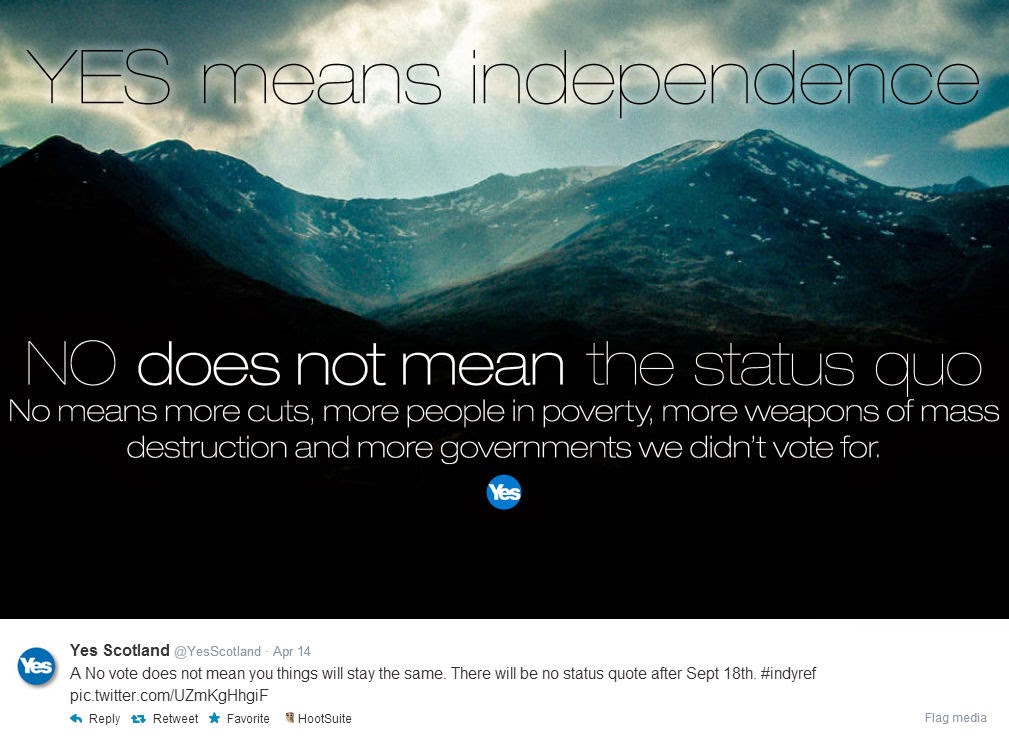
So what about SNP/#YesScotland's scaremongering and negativity? Perhaps the most negative piece of baseless #indyref scaremongering came from Nicola Sturgeon when on 18th of October 2013 she claimed that Westminster would "turn the screw" on Scotland if we voted no. More recently Scots have seen a series of highly negative massages being published on-line and in print by SNP/#YesScotland. Three examples are below. 


Monday, 14 April 2014

Some thoughts on SNP / #YesScotland's latest flyer.

Some thoughts on SNP / #YesScotland's latest flyer.


Mistruth and assertion? Let's go through it point-by-point:

1. The UK is one of the wealthiest countries on the planet. We have the fastest growing economy in the western world and will soon have the EU's largest economy.  

2. The FT report is superficial and now quite dated. The SNP Gov's own GERS report shows that our deficit (inc oil) is higher than rUK. We spend about £12.7bn more than we earn. 

3. That's not how democracy works. You don't always get who you vote for. I voted for neither Cameron nor Salmond.

4. Trident actually costs £170m per year and employs 6,500 people. There have also been persistent reports that the SNP may want us to keep Trident.

5. After the euro crisis, no rUK PM will be able to convince the public that a currency union with a foreign country with a huge banking sector is a good idea.

6. Everyone agrees on this. The question is when and on what terms. 

7. Not guaranteed.

8. We can do this right now - childcare is devolved. Nonetheless, Holyrood civil servants say Salmond's childcare plans are not funded. 

9. This is 100% correct, but Salmond will run the 2014-16 negotiations.

Friday, 11 April 2014

Oh dear, SNP/#YesScot have been caught fibbing again!

Oh dear, SNP/#YesScot have been caught fibbing again!

SNP/YesScotland published a Panelbase poll yesterday. Along with the results this was also tweeted:

Now anyone who bothered to go to school will spot that there are no data points on the plot, but there are wobbly trend lines. Let's look at the actual data:


Note that on the second plot #bettertogether have a 10 point lead, whereas on the first one this is reduced to 5%. Lets add the SNP/#YesScot trend lines in bold for fun:


No doubt this was a genuine error or perhaps the SNP/YesScotland  plot only refers to Panelbase data. After all, it tends to flatter them a little. This shows Panelbase only data with the SNP/#YesScot trend lines shown in bold.


So no matter how we look at it, SNP/#YesScot have been trying to fool the people of Scotland.

Monday, 7 April 2014

#indyref Myths

Myth #1 - Vote Yes to get rid of Trident 

Wrong! If Scotland leaves the UK it would be the 2016 parliament that decides what could happen to Faslane and the 6000 Scots who work there. Although Trident is a hot topic within the SNP, there is no real evidence that Scots like/dislike it less than the rest of the UK. If the submarines were to leave, it could take decades and then the site would then have to be made safe at an "enormous" cost. But don't worry, anonymous sources within the SNP have said keeping "Trident on the Clyde will be price of keeping the pound".

At the same time as negotiating the removal of the submarines, the Scottish Government will be negotiating membership on the NATO and its policy of "Nuclear Sharing" and "Nuclear First Strike". Salmond's plan is that an independent Scotland would allow submarines and warships armed with nuclear weapons from the US, Britain and other Nato countries to dock in its ports. Indeed, he has also said he'd welcome the USA establishing bases in Scotland.)

When all this is happing Scotland will be seeking a site to store its long-term nuclear waste (from power plants the SNP Gov have used beyond their design life - "sweating").
Clear? 


Myth #2 - Indyref is not about the SNP.

We know that #YesScotland is dominated by the SNP in terms of staff and funding. No other party has given money to #YesScotland - in fact, they benefit from the extra exposure #YesScot gives them.

Nonetheless, this tweet from the SSP shows us two things:


Myth #3 - A Yes vote mean saying goodbye to the Tories!

Now the first thing to remember is that quite a lot of people in Scotland vote Tory. It is like masturbation: a lot of people do it, but only a few admit to it! The image below shows that at the last General Election the Tories, the SNP & the Lib-Dems all had about the same vote share.

So why all the fuss about the Tories then? The answer is simple: the SNP need Labour voters on their side if they are to win #indyref.  It was not always like this. Indeed, in the 2007-11 parliament the SNP relied on Tory support to pass each of its budgets. This is because, there is a synergy between the "conservative" polices both SNP and the Tories aspire to. Ruth Davidson on SNP voters: "A significant proportion of them have voted Conservative in the past, the Tartan Tories that exist within the SNP as they call them". The key to Salmond's success has been is ability to dress up his regressive polices as something which benefit the working class. Some would call it dishonest.